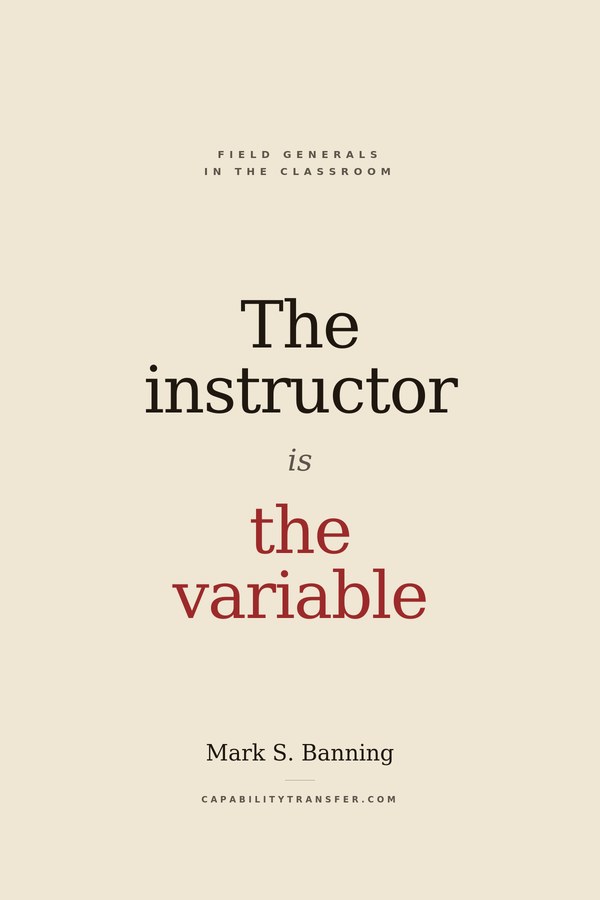
This book started as a long argument I had been making in pieces across my career, and finally decided to put down in one place. The argument is simple to state and harder to live with: most training doesn't produce capability because most organizations have been confusing the wrong thing for instruction. They have been picking subject matter experts, handing them rooms, and assuming knowledge of the material would translate into the ability to develop other people's capability. It mostly doesn't. The instructor is the variable that determines whether a program produces graduates who can do the work or just graduates who attended the sessions. Field Generals in the Classroom is the case for treating that variable seriously — and the architecture for doing it.
The book opens with a question I like to ask anyone in this field: who was the best teacher you ever had? Most people can answer in seconds. Then I ask how many people have taught them something across their lives — dozens, often more — and how many produced that same memorable experience. For most people the answer is two or three. Maybe fewer. That gap is the gap between what most training is and what it could be. The book is about closing it.
The central analogy is the football quarterback — what football calls the field general. I played the position when I was younger, which gave me an early sense of what it required. The quarterback touches the ball on every offensive play. The play is called in the huddle, but the quarterback walks to the line of scrimmage and reads the defense in real time. They run the play that's right, not just the play that was called. That's what an instructor actually does in a room. They walk in with material, but the material isn't what runs the show. They are. The book uses ten specific decisions a quarterback makes on the field and shows the same decision happening in a classroom — the pre-snap read, the audible at the line, the checkdown, the timeout, the safe handoff, the two-minute drill, knowing when to take the sack rather than force a throw into coverage. Different field, same decisions.
Part One makes the case. It includes a five-minute diagnostic any executive can run on their own roster — the season-length diagnostic — that surfaces, in numerical form, whether the organization is developing instructors or just rotating them through assignments. It introduces the Three-Legged Stool framework that describes what an instructional environment requires to produce genuine capability rather than performed coverage. Each leg converges with established research — Amy Edmondson on psychological safety, K. Anders Ericsson on deliberate practice, Lee Shulman on Pedagogical Content Knowledge — but the framework itself was built from forty years of practice rather than from the literature. The convergences were identified after the observations were made, which is the honest order of events.
Part Two is about implementation. The diligence period that should precede any meaningful change. The first hundred days. The 30/60/90 sequence. The two specific mistakes most organizations make when they try to upgrade their instructor pool — confusing enthusiasm for instruction, and treating subject matter experts as interchangeable instructors. Ten sections walk through selection, development, the calibration relationship between instructor and developer, the full season as the unit of development, the hand-off from one instructor cohort to the next that makes the practice self-generating. The architecture is detailed enough to run yourself if you want to.
The book includes one operational case from earlier in my career: a 21-point SAP exam pass rate improvement at Price Waterhouse, achieved under significant constraints, through a partial implementation of the ownership principle described in the framework. Not the full architecture — just one principle, applied deliberately. The number moved. That was the proof of concept that the principle was real, and decades of subsequent work was what built the rest of the architecture around it.
The book closes with where to begin. Eight specific steps, in order. Start with the diagnostic. Identify the informal quarterbacks already in your organization. Build one calibration relationship. Pick one curriculum and protect one full season. The deliberate process described in the book doesn't respond well to organizational urgency, and the reader who tries to compress the runway will produce the same partial results the rotation logic produces. Start small. The rest follows.
There is a section near the end called If you want help — the engagement architecture for readers who want to apply the framework with someone who has done this work before. It's available, but the book is designed to be self-sufficient. Most readers should be able to run the methodology themselves.
The closing is a personal note. If you read this book and ran any part of it in your own function, I want to hear what happened. The successes are useful. The failures are more useful. The first cup of coffee in San Antonio is on me.
It's free. Take it.