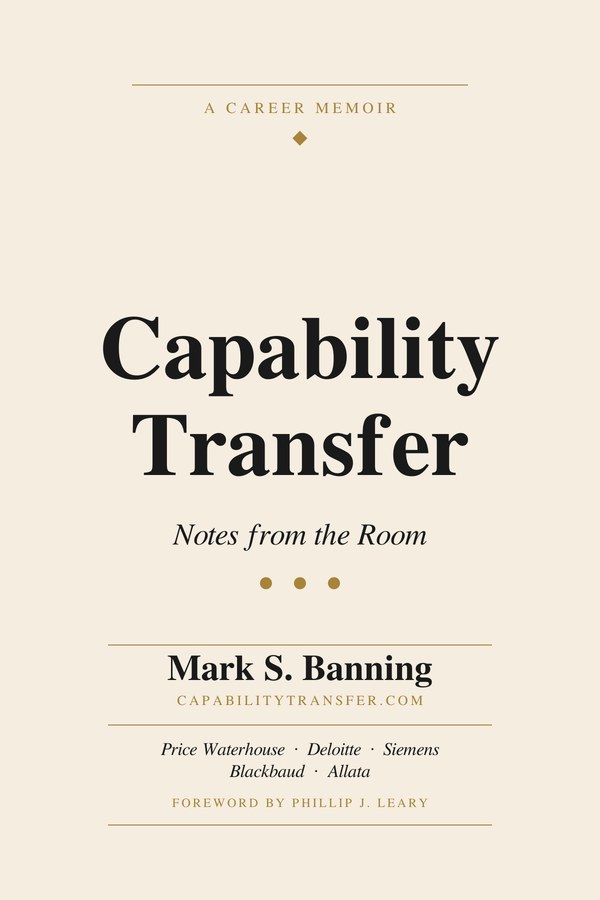
I spent four decades learning how to develop genuine capability in people — at Price Waterhouse, Deloitte, Siemens, Blackbaud, and Allata, in rooms where the work was real and the stakes mattered.
I wrote two books to share what I learned. Capability Transfer is a career memoir — what the work actually looked like across forty years of practice. Field Generals in the Classroom is the focused argument about why most training doesn't produce capability and what to do about it.
Both are free. They're meant to be in the hands of every practitioner who needs them. If they're useful to you, take them and put them to work. If you ever want to talk shop about any of it, I'd love that — more on that below.


I built this to help readers test the methodology against their own situation without committing to 600 pages first. Eight inputs, two minutes, an honest range against your actual operation. Some functions have substantial recovery available. Some don't. The tool will tell you which one you're looking at.
Run the estimatorThe books are designed to be self-sufficient. A practitioner who reads carefully should be able to run the methodology in their own organization without me, and that's how I'd prefer it.
Some readers reach a point where they want help anyway — either because the situation has gotten complicated, or because they want a second pair of eyes on the work, or because having someone who's done this kind of work walk alongside them while they do it is just easier than going it alone.
That's what the consulting practice is for. The work is bounded engagements scaled to your specific situation, the pricing is transparent, and the goal is the capability to do this without me — which is also how I measure whether the engagement worked.
The practice focuses on training organizations whose customers can leave for competitors. Vendor training arms, customer-facing training profit centers, professional services training operations. Outside that focus the books may still be useful even if engagement isn't the right shape.
So if you want a sounding board for an idea you're working through, or if there's something in the books you want to push back on or extend, or if you just want to compare notes — please reach out. There's no agenda I'm holding on the other side of the email. If I have time on my calendar, the conversation is yours.
And if you're ever in the San Antonio area, the first cup of coffee is on me.
Same email works. Tell me about your function and what you're working through, and I'll respond personally. We can talk about whether engagement makes sense, what shape it might take, and what it would cost. If we decide together that it's not the right fit, we'll have had a useful conversation either way.